
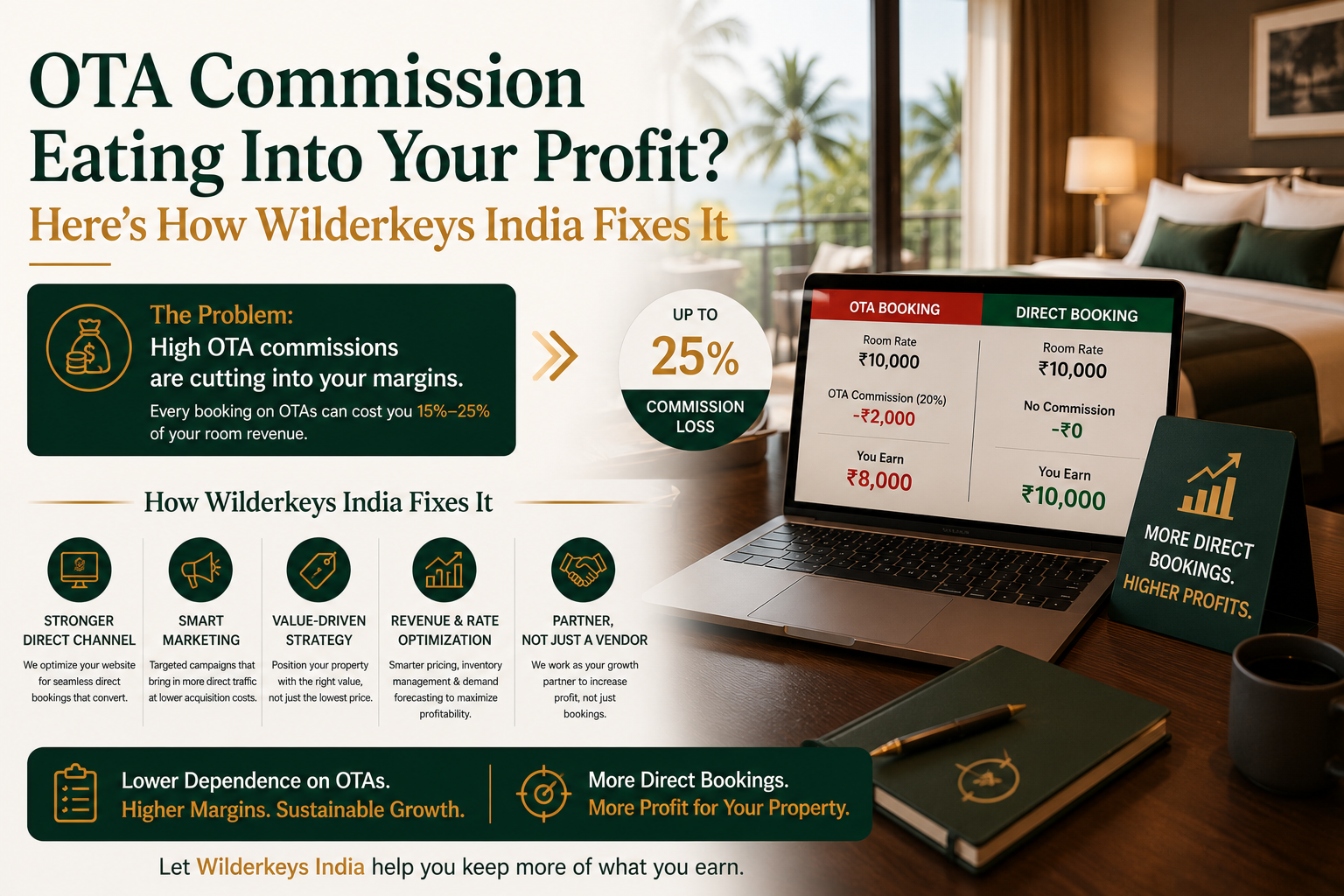
Every time a guest books your hotel through MakeMyTrip, Booking.com, or Agoda, you pay a commission. That commission feels manageable on a single booking. Multiply it across a full year of reservations — and the number becomes quietly devastating.
For most independent hotels, resorts, and villas in India, OTA commissions represent one of the single largest operating costs on the P&L. And unlike staffing or utilities, it is a cost that scales directly with your revenue — the more you earn, the more you give away.
In this blog, we break down exactly how much OTA commissions are costing your property, what the hidden costs look like beyond the headline percentage, and how Wilderkeys India’s distribution management service builds a channel mix that protects your margin.
What OTA Commissions Are Really Costing Indian Hotels in 2026
Let us start with the numbers most hotel owners know but rarely calculate in full.
| OTA Platform | Standard Commission |
| MakeMyTrip/ Goibibo | 15% – 25% |
| Booking.com | 15% – 20% |
| Agoda | 15% – 20% |
| Cleartrip | 18% – 25% |
| Airbnb | 25.5% (host fee) |
Now apply those percentages to real property:
| Annual Room Revenue | OTA Share | Avg. commission | Annual Commission Paid | Net Revenue Lost |
| Rs 1 Crore | 60% | 20% | Rs 12 Lakh | Rs 12 Lakh/year |
| Rs 2 Crore | 60% | 20% | Rs 24 Lakh | Rs 24 Lakh/year |
| Rs 5 Crore | 60% | 20% | Rs 60 Lakh | Rs 60 Lakh/year |
| Rs 5 Crore | 80% | 20% | Rs 80 Lakh | Rs 80 Lakh/year |
For a hotel doing Rs 5 Crore in annual revenue with 80% OTA dependency, common during peak periods, commission alone accounts for Rs 80 lakh annually. That is revenue that never reaches your account.
The Hidden Costs Beyond the Commission Percentage
Commission is the visible cost. But hotel owners who have analysed their OTA relationships closely find that the true cost of OTA dependency runs significantly higher once hidden factors are included.
1. Rate Parity Clauses Limit Your Direct Competitiveness
Most OTA contracts include rate parity clauses, meaning your website cannot publicly offer a lower rate than what appears on the OTA. This structurally limits your ability to compete for direct bookings on price.
OTAs frequently undercut the rates hotels set through mobile-only discounts, loyalty member pricing, and Genius or VIP rates. A rate parity analysis across major platforms found that a significant proportion of properties had at least one OTA displaying a rate lower than their own website on any given day, with the average undercut at 8–12%.
2. Guest Data Belongs to the OTA – Not To You
Every OTA booking is a guest relationship you do not own. The OTA controls the guest’s email, booking preferences, and future contact – making repeat bookings through your direct channel far harder to generate.
Hotels with strong direct booking strategies see repeat booking rates of 30–40% from their own guest database. OTA-acquired guests generate repeat direct bookings at only 5–8%. Each guest whose data you do not own represents three to five lost future bookings over a five-year period.
3. Cancellation Rates Are Dramatically Higher on OTAs
OTA bookings carry a cancellation rate of approximately 50%, compared to just 18% for direct bookings significantly impacting revenue forecasting and operational planning.
The instability this creates is not just an inconvenience it creates forecasting gaps that force conservative pricing decisions, reducing your ability to hold firm on rates during compression windows.
4. Preferred Partner Programmes Escalate the True Rate
Paying extra commission for visibility through Preferred Partner Programmes (Booking.com, MMT select, Agoda Preferred) further increases your effective commission rate – often by 5-20 percentage points above the standard rate.
The result: a property already paying 20% commission that participates in preferred programmes to maintain visibility may be effectively paying 23–25% on those bookings, compounding the margin erosion.
5. Brand Dilution on Commodity Platforms
On an OTA, your boutique resort, heritage property, or private villa competes on the same template as a budget guesthouse – price, location, and review score. Your brand story, design aesthetic, and unique value proposition are reduced to a standard listing. Over time, this trains guests to view your property as a commodity, making it harder to command premium ADR even through channels.
How Wilderkeys India Fixes It?
Reducing OTA commission does not mean abandoning OTAs – it means using them strategically while actively building channels that retain more of your revenue. Wilderkeys India manages this complete distribution shift for your property, across five interconnected areas.
1. Channel Mix Audit & OTA Commission Analysis
We start with a full audit of your current distribution mix – which OTAs you are listed on, what commission you are paying per channel, how bookings are distributed across platforms, and where your true net ADR stands after commission.
Most independent hotels have never calculated their blended commission rate or compared net ADR by channel. This audit alone surfaces significant revenue leakage that is immediately actionable.
How Wilderkeys India fixes this: We identify exactly which channels are costing you the most relative to the bookings they generate, and which ones are worth retaining, renegotiating, or reducing.
2. Direct Booking Channel development
The most effective long-term fix for OTA commission pressure is a growing direct booking base. Wilderkeys India builds and manages the strategy that makes this happen — without violating OTA rate parity agreements.
- Direct-booking exclusive benefits: early check-in, late checkout, complimentary upgrades, welcome amenities — added value that OTAs cannot match or take commission on
- Member-only rates and bundled packages: structured to comply with parity clauses while offering genuine direct-booking incentives
- Repeat guest campaigns: converting OTA-acquired guests into direct bookers for their next stay through post-stay communication and loyalty incentives
- Direct inquiry management: responding to all website and WhatsApp inquiries faster than OTA alternatives, so guests who find you directly have a reason to stay direct
The data on what this delivers: Hotels starting at 15% direct booking share typically reach 25–30% in year one with consistent execution. Year two: 30–40%. Year three: 40–50%. Every percentage point shifted from OTA to direct permanently adds margin.
How Wilderkeys India fixes this: We design and manage your complete direct booking incentive programme, guest communication flow, and post-stay conversion strategy – so direct share grows sustainably, year on year.
3. OTA Listing Optimisation – More Bookings, Same Commission
If you are on OTAs — and you should be — the goal is maximum conversion from minimum inventory allocation. A poorly-optimised OTA listing wastes commission by generating fewer bookings per impression than a well-presented one.
- Professional photography and lifestyle imagery — fresh photos boost conversion by 20–30% on MakeMyTrip listings
- Complete, keyword-rich property descriptions across all platforms
- Review response management to protect ranking and conversion rate
- Strategic participation in MakeMyTrip Select, Booking.com Preferred, and Agoda Preferred — only where the booking volume justifies the commission premium
How Wilderkeys India fixes this: We manage your complete OTA presence – listings, imagery, descriptions, review responses, and programme participation – so your OTA spend generates the highest possible return.
4. Real-Time Rate Inventory Management Across All Channels
Commission leakage accelerates when rates are inconsistent across channels — either through accidental undercutting, slow inventory sync, or poor parity management. Wilderkeys India manages your rates and inventory in real time across every distribution channel, ensuring consistent pricing and eliminating the sync errors that lead to double bookings, lost bookings, and OTA penalties.
How Wilderkeys India fixes this: We maintain real-time rate and inventory parity across your full channel mix – so your distribution is always clean, consistent, and positioned to maximise both conversions and net revenue.
5. Net ADR Tracking and Commission Reporting
Most hotels track gross ADR — the rate the guest pays. What matters is net ADR — what you actually receive after commission. Wilderkeys India builds net ADR tracking into your regular reporting so you can see precisely which channels are profitable and which are subsidising your guests.
How Wilderkeys India fixes this: Youreceive clear, regular reporting on net ADR by channel, commission paid per platform, direct vs OTA booking split – giving you full commercial visibility to make informed distribution decisions.