
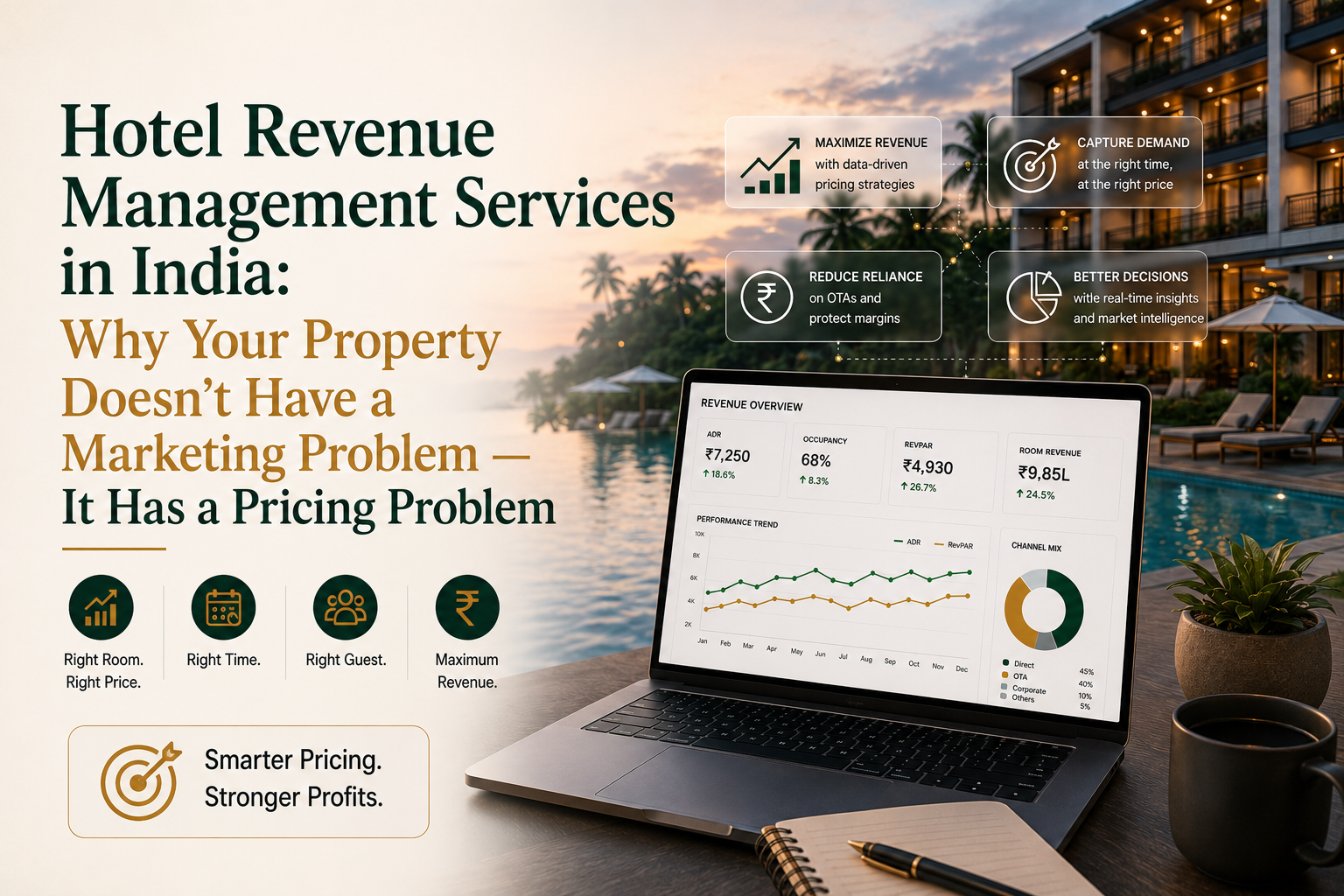
Most independent hotels and resorts in India come to a hotel revenue management company asking for the same thing: more bookings. More traffic, more leads, more visibility on Google and Instagram. It’s the natural instinct — if rooms are empty, the assumption is that not enough people know the property exists.
But after working with mid-range and boutique properties across pilgrimage routes, hill destinations, and offbeat retreats, a different pattern shows up almost every time: the property isn’t invisible. It’s mispriced, misaligned, and leaking revenue through a dozen small decisions nobody is tracking — which is exactly the gap hotel revenue management services are built to close.
This is the piece most digital marketing conversations skip. And it’s the piece Wilderkeys India treats as inseparable from marketing, not an afterthought to it.
The Real Problem Isn’t Demand. It’s Revenue Leakage.
Take a resort with a 65% occupancy rate. On paper, that sounds like a marketing gap — 35% of rooms sitting empty, waiting for more visibility. But pull the numbers apart with a proper revenue management audit, and a different story usually emerges:
- Rooms are priced the same on a random Tuesday in July as they are during a festival weekend — a clear sign of missing dynamic pricing strategy
- The OTA commission is quietly taking 15-20% on bookings that could have converted directly, at full margin, with the right nudge on the website
- Weekday corporate or wellness travelers — a segment with real demand — are being priced identically to weekend leisure travelers, so neither segment is optimally captured through proper rate segmentation
- The property is chasing broad, expensive hotel SEO keywords (“luxury resort near X”) when the traffic that actually converts is bottom-of-funnel and route-specific
None of this is a visibility problem. It’s a revenue optimization problem. And no amount of additional traffic fixes a pricing structure that’s leaving RevPAR (revenue per available room) on the table with every single booking that does come through.
Why Revenue Management Gets Overlooked in Indian Hospitality?
Hotel revenue management as a discipline is standard practice at large chains — they employ dedicated revenue managers, dynamic pricing engines, and daily rate reviews. But independent and boutique properties in India — the ones actually driving the growth of experiential travel — almost never have this function in-house. It falls into a gap: the owner is busy with operations, the marketing agency is focused on lead generation, and nobody owns pricing strategy and channel distribution end-to-end.
The result is a strange inefficiency: properties investing real budget into Google Ads and social media to drive traffic toward a pricing structure that hasn’t been reviewed in months, sometimes years. It’s like tuning the engine of a car with a flat tyre — which is exactly why revenue management consulting needs to sit alongside, not separate from, digital marketing.
What Hotel Revenue Management Services Actually Look Like When Done Right
This isn’t about a static rate calendar or blanket seasonal price hikes. Done properly, professional revenue management for hotels looks like:
Dynamic pricing, not calendar-based pricing. Rates should move with actual booking pace and real-time demand signals — a pilgrimage season surge, a long weekend, a regional festival — not just a static “peak season” block set once a year. This is the core of any credible dynamic rate optimization strategy.
Channel cost and OTA management. Every booking through an OTA carries a real, quantifiable cost. A sound channel management strategy means knowing exactly when it’s worth paying that commission for exposure, and when a direct booking strategy — through retargeting, WhatsApp, or a stronger website CTA — makes more financial sense.
Segment-specific rate logic. A honeymoon traveler, a corporate offsite booker, and a solo backpacker have different price sensitivity and different booking lead times. Treating them identically is the single most common mistake independent properties make when they lack proper market segmentation in their pricing.
Marketing and revenue strategy built as one system. This is where most hotel SEO agencies stop short — they’ll run the ads and build the funnel, but leave pricing decisions entirely to the property owner, disconnected from what’s actually driving traffic and conversion.
Why Revenue Services Belong Inside a Marketing Engagement, Not Separate From It
Ad spend and content strategy answer the question, “how do we get more people to look at this property?” Revenue management services answer a different, equally important question: “when someone does look, are we capturing the right value from them?”
Running one without the other means optimizing half a system. Wilderkeys India’s approach treats hotel revenue management as inseparable from digital marketing — auditing pricing, OTA vs. direct booking mix, and booking flow alongside SEO and campaign work, not as a separate line item bolted on afterward. It’s the same instinct behind identifying wasted ad spend on mismatched luxury keywords for a mid-range pilgrimage-route property: the fix wasn’t more traffic, it was traffic aligned to the right price point, driven by real revenue data.
The Question Worth Asking Before the Next Campaign
If you’re an independent property owner about to greenlight another round of ad spend, the more useful first question isn’t “how do we get more visibility?”
It’s: “Are we pricing today’s demand correctly — or are we just marketing our way around a broken revenue strategy?” For most boutique and mid-range hotels and resorts, the honest answer is somewhere in between. And closing that gap — through proper hotel revenue management services — is exactly where sustainable, profitable growth starts.