
Running a hotel, resort, or villa in India has always required managing many things at once. But in 2026, the commercial complexity has grown significantly — dynamic OTA algorithms, event-driven demand spikes, rising operating costs, and guests who research more thoroughly than ever before.
Many independent property owners know something isn’t working, but can’t quite identify what. Revenue looks reasonable on paper, the hotel is mostly full, and yet profit margins stay stubbornly flat. Sound familiar?
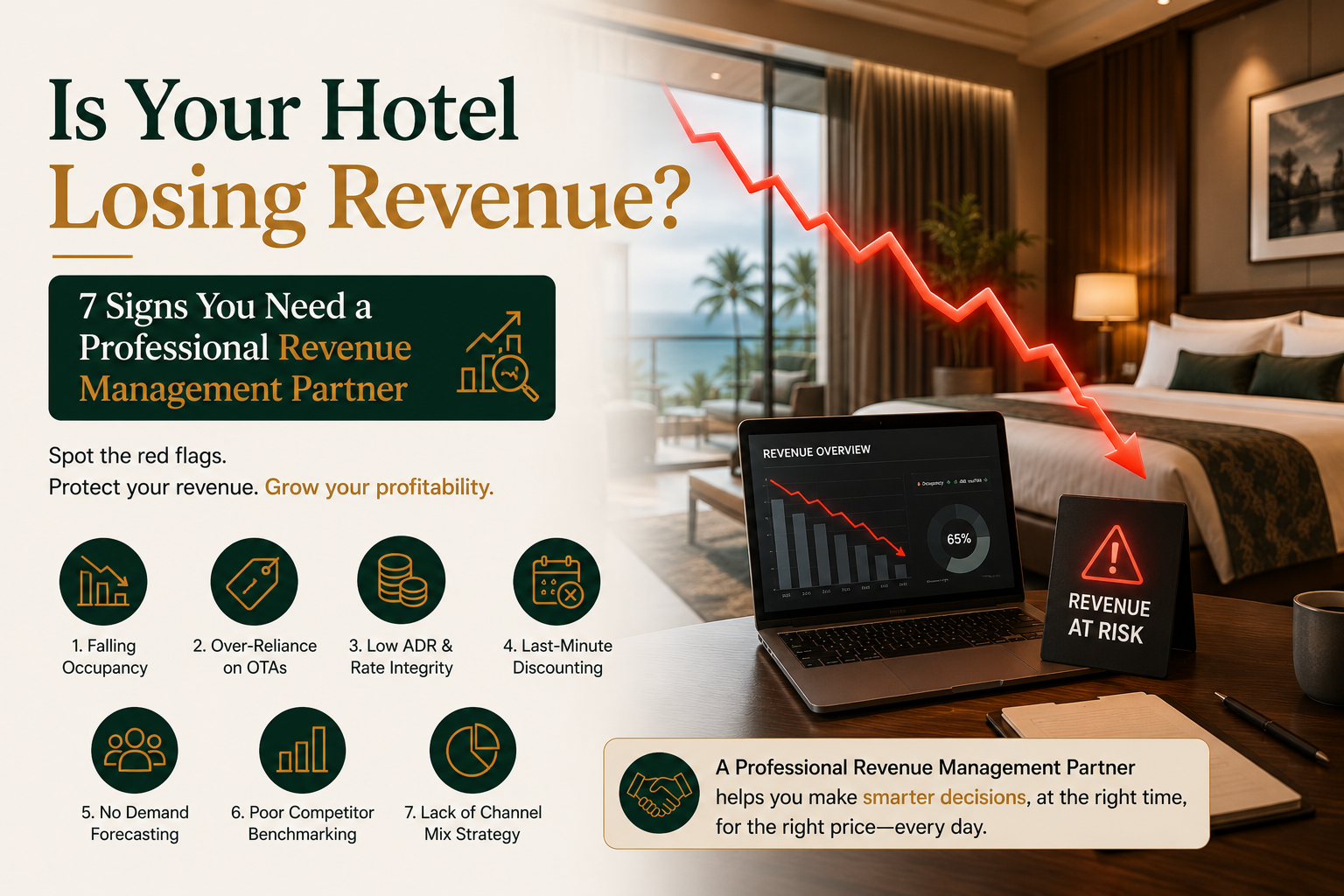
Below are seven signs that your property is leaving revenue on the table — and that it’s time to bring in a professional revenue management partner.
Sign 1: Your Hotel is Full – But Profit Margins Are Still Flat
A fully occupied hotel feels like success. But if your profit isn’t growing alongside your bookings, the problem isn’t demand — it’s how that demand is being priced and distributed.
What’s really happening: You may be filling rooms at rates below where the market would actually pay, or selling through channels that strip 15–25% commission off every booking before it reaches you. A property at 90% occupancy priced 20% below market is still underperforming — it has simply subsidised its guests while looking successful on the surface.
The data confirms it: Many Indian hotels are running at 80–85% occupancy in 2026, yet struggling to grow gross operating profit because pricing decisions are reactive and channel mix is not optimised.
Sign 2: You Are Setting Rates by Season, Not by Demand
If your pricing strategy looks something like peak rate, off-season rate, and a Diwali special — and those rates stay unchanged for months at a time — you are almost certainly underpricing high-demand nights and overpricing slow ones.
What’s really happening: India’s hotel demand is event-driven, not linear. Weddings, MICE events, pilgrimage seasons, IPL matches, and long weekends create sharp compression windows that a static rate calendar cannot respond to. By the time your own occupancy data signals high demand, the best pricing window for those remaining rooms has already passed.
What it costs you: Revenue that should be yours during peak compression goes to faster-pricing competitors who are monitoring demand signals in real time.
Sign 3: More than 60% of Your Bookings Come Through OTAs
OTAs are a critical distribution channel — but when they account for the majority of your bookings, you are effectively paying 15–25% commission on revenue that could have come to you directly at full margin.
What’s really happening: Without a strong direct booking channel and an active strategy to grow it, OTAs become the default — not because they are the best option, but because managing direct demand efficiently takes systems and attention that most independent properties do not have in-house.
The India context: OTA bookings can contribute more than 60% of total reservations for Indian independent hotels, and can reach 80% during certain periods — making the commission burden one of the largest single drags on net revenue for these properties.
Sign 4: Your Competitors Are Consistently Priced Higher Than You
Rate benchmarking — systematically tracking what your true competitive set is charging — is one of the most powerful, underused revenue tools available to independent Indian hoteliers.
What’s really happening: Most independent properties check competitor rates infrequently, if at all. Even a basic weekly check of four to five genuine competitor rates changes pricing decisions meaningfully — a competitor moving to stop-sell is a demand signal you can act on before your own occupancy data reflects it.
What it costs you: If you consistently sit below your competitive set without a clear value justification, guests interpret the lower rate as a lower-quality signal — which can hurt both bookings and the type of guests you attract.
Sign 5: You Have No Visibility Into Future Booking Pace
Revenue management is fundamentally forward-looking. The ability to see how quickly future dates are filling — and compare that pace against historical patterns and current competitor behaviour — is what allows you to price ahead of demand rather than react to it.
What’s really happening: Most independent properties make pricing decisions based on how full they are today, not how full they are likely to be in 30, 60, or 90 days. This means slow periods get discounted reactively — often more than necessary — and strong periods get underpriced because the demand signal wasn’t spotted early enough.
What professional revenue management delivers: Advanced demand forecasting with accuracy rates approaching 95% at 90-day horizons, giving your property a structured view of future performance before those windows close.
Sign 6: Your Wedding And Peak Season Revenue Isn’t Growing
India’s hospitality demand is uniquely event-driven. Wedding clusters in destinations like Jaipur, Udaipur, Goa, and Himachal Pradesh create sharp compression windows where the right pricing strategy can deliver 20–40% ADR premiums over standard rates.
What’s really happening: Properties without a proactive event-pricing strategy either sell out too early at standard rates, or hold inventory expecting higher rates that never materialise because the approach wasn’t structured. Wedding and MICE bookings require dedicated package pricing, minimum stays, and inventory controls — not just a rate increase.
The data: Major hotel groups have reported wedding-related bookings up 25% year-on-year in 2026, projecting a 15% ADR lift across flagship properties from wedding and MICE demand alone. Independent properties that build dedicated event strategies are capturing a disproportionate share of this growth.
Sign 7: Revenue Management Is Taking Time Away From Hosting
This is perhaps the most honest sign of all. Independent hotel owners get into hospitality to create great guest experiences — not to become revenue analysts, distribution managers, and data interpreters simultaneously.
What’s really happening: Without dedicated revenue management infrastructure — the right systems, data access, and expertise — these tasks fall to whoever is available. The result is that revenue decisions get made reactively, inconsistently, and without the commercial rigour that protects margin.
The cost is invisible: Unlike an empty room, the cost of a poorly-made pricing decision or a missed demand window doesn’t show up as a line item. It simply never appears as revenue you could have earned.
How Many of These Signs Apply to Your Property?
| Signs that apply to your property | What it Means |
| 1-2 signs | Revenue gaps exist but are manageable. A revenue audit will identify quick wins. |
| 3-4 signs | Significant revenue is being left on the table. A revenue management partner will deliver measurable ROI. |
| 5-7 signs | Your property needs a full revenue management overhaul. The opportunity cost of waiting is growing every month |
How Wilderkeys India Will Helps You Turn This Around
Every sign above reflects the same underlying gap: independent hotels, resorts, and villas are being asked to compete at the commercial level of a branded chain — dynamic pricing, distribution strategy, demand forecasting, channel management — without the team, systems, or expertise that a chain has behind it.
Wilderkeys India’s Reservation & Revenue Management Services are built to close that gap, completely and professionally.
Dynamic, Demand-Led Pricing
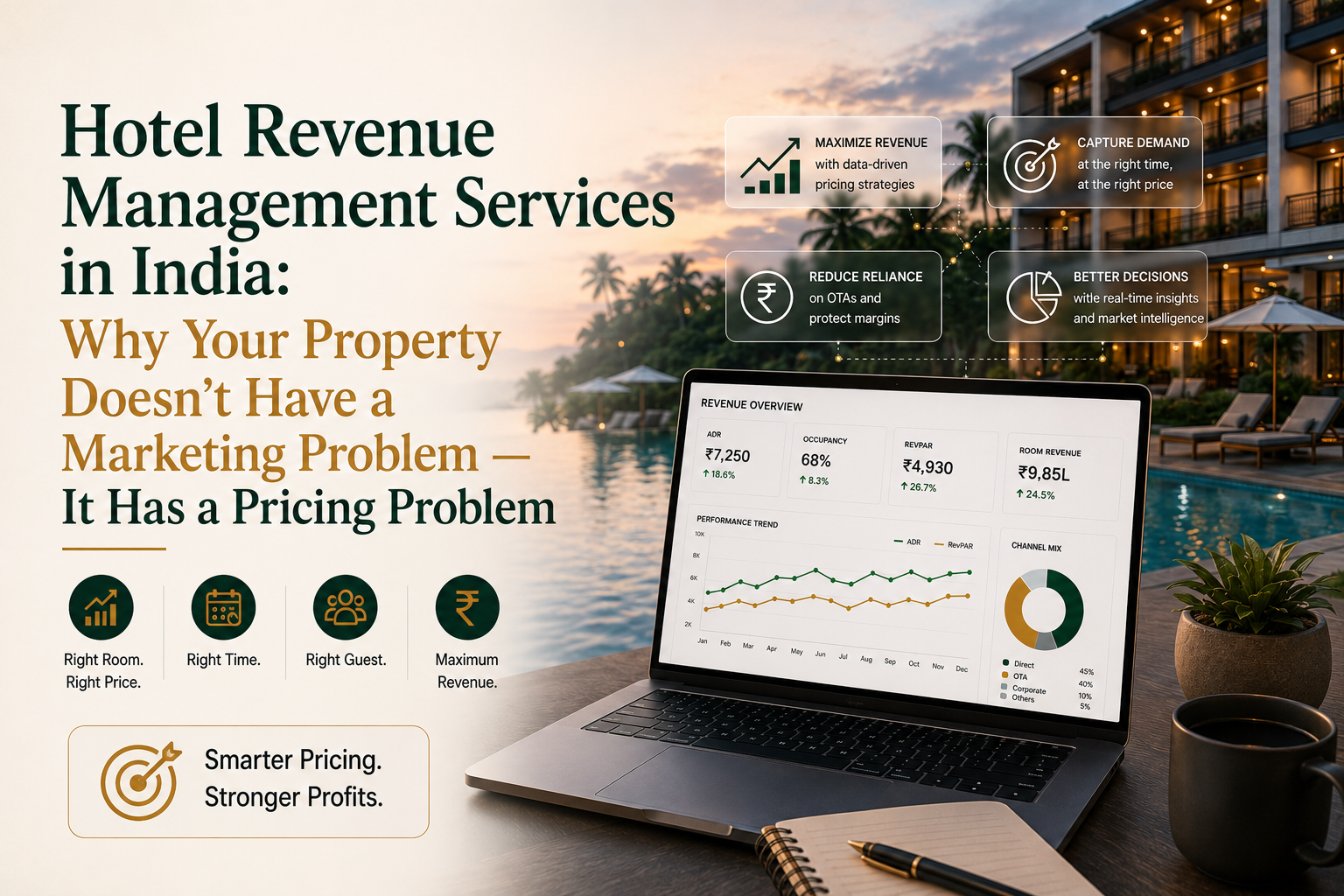
We build and manage a rate strategy specific to your property and destination — adjusting in real time to booking pace, competitor rates, and India’s event-driven demand calendar, so every room is priced to match what the market will actually pay.
Full OTA & Channel Management
We manage your complete distribution mix — rates, availability, and inventory across every OTA — while actively building your direct booking base to reduce commission dependency and protect your net ADR.
Demand Forecasting & Compression Planning
We map your 30, 60, and 90-day demand outlook in advance so your property is priced ahead of wedding clusters, festival spikes, and MICE windows — not reacting to them after the fact.
Weekly Competitive Benchmarking
We monitor your true competitive set on a consistent, structured basis — so your rates always reflect real market position rather than guesswork or outdated seasonal assumptions.
Transparent Performance Reporting
You receive clear, regular reporting on occupancy, ADR, RevPAR, pickup trends, and channel performance — giving you full visibility into how your property is performing and where the next revenue opportunity lies.