

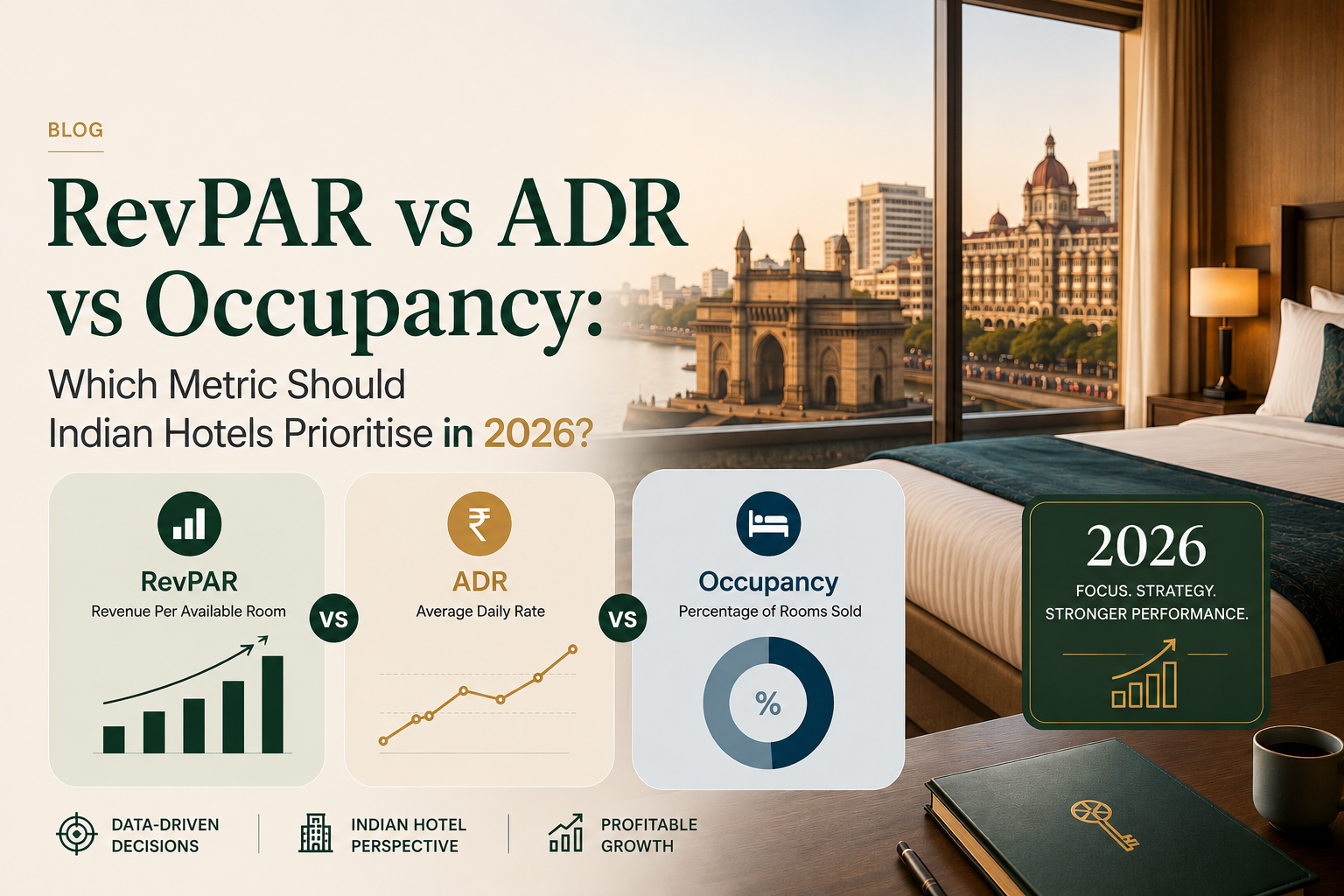
What are RevPAR, ADR, and Occupancy Rate?
What is RevPAR?
RevPAR stands for Revenue Per Available Room and measures how much revenue your hotel generates per available room, not just per occupied room. It serves as one of the most important factors of a hotel’s revenue health.
RevPAR = ADR * Occupancy Rate
OR = Total Room Revenue ÷ Total Available Rooms
What is ADR?
ADR stands for Average Daily Rate and measures the average revenue earned per occupied room per night. It basically reflects your pricing strategy on the rooms you actually sell, but it says nothing about the rooms.
ADR = Total Room Revenue ÷ Number of Rooms Sold
What is Occupancy Rate?
Occupancy rate is the percentage of available rooms booked during a specific period. It indicates how occupied the hotel is, but it does not reflect the rates at which rooms were sold.
Occupancy Rate = (Rooms Occupied ÷ Total Rooms Available) * 100
RevPAR vs ADR vs Occupancy
| Metric | What it Measures | Formula | What it misses |
| RevPAR | Revenue efficiency across all rooms | ADR * Occupancy | Costs, F&B, ancillary revenue |
| ADR | Pricing strength on occupied rooms | Room Revenue ÷ Rooms Sold | Empty rooms, demand signals |
| Occupancy Rate | How full your hotel is | Rooms sold ÷ Available * 100 | Rate quality, profitability |
Why RevPAR is the Metric Indian Hotels Should Lead in 2026?
RevPAR (Revenue Per Available Room) is widely regarded as one of the most important metrics in hotel revenue management. Used by hotel owners, investors, asset managers, and revenue professionals across the hospitality industry, it provides a clear view of how effectively a property is generating revenue from its available room inventory.
What makes RevPAR particularly valuable is that it combines two key hotel performance indicators—Occupancy Rate and Average Daily Rate (ADR)—into a single metric. Rather than looking at room demand or pricing in isolation, RevPAR measures how well both factors work together to drive revenue.
For example, a hotel may achieve high occupancy by offering heavily discounted rates, while another property may maintain premium pricing but struggle to fill rooms consistently. Looking at occupancy or ADR alone can create a misleading picture of performance. RevPAR helps bridge that gap by showing the actual revenue generated from available rooms, making it a more accurate measure of overall hotel performance.
This is why RevPAR remains a core benchmark for evaluating pricing strategies, identifying revenue opportunities, measuring competitive performance, and making informed business decisions. It enables hoteliers to understand whether they are maximizing revenue potential while maintaining a healthy balance between room rates and occupancy.
For hotels focused on sustainable growth, stronger profitability, and long-term commercial success, RevPAR continues to be one of the most reliable indicators of revenue efficiency. By capturing both demand and pricing performance in a single metric, it offers a comprehensive view of how effectively a hotel is converting its room inventory into revenue.
India’s RevPAR Reality in 2025-26
India’s hotel industry numbers make the RevPAR story much clearer:
- Nationwide: The performance of India’s hospitality sector closed in FY2024-25 with an ADR of Rs 8,525 (+5.8% YoY) and a RevPAR of Rs 5,845 (+7.6% YoY), with an average occupancy of 68.5%, according to the Global Asset Solutions India Market Outlook Report.
- Top performers: According to Hotelivate 2025, India’s top 100 hotels significantly outperformed the broader hospitality market, achieving a RevPAR that was 71% higher than the national average. These properties recorded an impressive occupancy rate of 74.4% while maintaining an Average Daily Rate (ADR) of ₹13,226, compared to the market-wide ADR of ₹8,432. The performance of these leading hotels demonstrates the impact of strong revenue management, effective pricing strategies, and consistent demand generation. Rather than relying solely on high occupancy, these properties successfully balanced room rates and occupancy levels to maximise revenue performance. This highlights why RevPAR remains one of the most important hotel KPIs, providing a clearer measure of commercial success than occupancy or ADR alone.
- Horwath HTL 2025: Occupancy stands at 64%, ADR increased 8.6% to Rs 8,624, and RevPAR increased by 10.8% to Rs 5,522 at the all-India level.
- Metro Markets: Insupply-constrained hotel markets such as Mumbai and Delhi, RevPAR growth has been largely driven by increases in Average Daily Rate (ADR) rather than occupancy gains. Strong travel demand combined with higher rates has maintained healthy occupancy levels. This demonstrates that in markets where new supply is restricted, effective pricing strategies and revenue management practices can play a crucial role in improving hotel revenue and overall profitability.
- Tier 2 & 3 cities: Destinations like Udaipur, Shimla, Rishikesh, Ranthambore, and Coorg have higher rates despite relatively lower occupancy, driven by weddings, spiritual tourism, and infrastructural growth.
When Should Each Metric Drive Your Decision-Making?
Average Daily Rate (ADR) shows how much revenue a hotel earns, on average, from each room that is sold. It is an essential metric for understanding pricing performance and determining whether a hotel’s room rates align with market demand. Simply put, ADR helps hoteliers understand whether guests are willing to pay the rates being offered. A rising ADR is often a strong indicator that a hotel’s pricing strategy, market positioning, and guest experience are aligned with demand.
For hotel owners and revenue managers, ADR provides valuable insight into pricing power. Even when occupancy remains stable, increasing ADR can significantly boost overall revenue and profitability. On the other hand, if demand is strong but ADR remains stagnant, it may indicate missed revenue opportunities and the need for a more effective pricing strategy.
Hotels should pay particular attention to ADR when operating in destinations where demand consistently exceeds supply. Properties located in popular hill stations, heritage destinations, luxury leisure markets, and boutique coastal locations often have greater flexibility to increase room rates without negatively impacting occupancy.
ADR should also be closely monitored when comparing performance against competing hotels, planning seasonal pricing strategies, or preparing for high-demand periods such as Diwali, Christmas, New Year’s Eve, long weekends, and wedding seasons. These periods often present opportunities to maximise revenue through strategic rate optimisation.
For hotels already maintaining occupancy levels above 70%, ADR becomes even more important. Rather than focusing solely on selling more rooms, improving room rates can be one of the most effective ways to increase revenue, strengthen profitability, and enhance overall hotel performance.
When to Focus on ADR:
• When your hotel operates in a high-demand, supply-constrained destination.
• When you want to benchmark room rates against competing hotels in your market.
• When planning seasonal pricing strategies for festive periods, holidays, and special events.
• When occupancy is already strong, and revenue growth depends on improving room rates rather than filling additional rooms.
• When evaluating the effectiveness of your hotel’s revenue management and pricing strategy.
When Should Hotels Focus on Occupancy Rate?
Occupancy Rate is one of the most important hotel performance metrics for measuring guest demand. It shows the percentage of available rooms that are occupied during a specific period and helps hoteliers understand how attractive their property is to travellers.
However, occupancy alone does not indicate profitability. A hotel operating at high occupancy with heavily discounted room rates may generate less revenue than a hotel with lower occupancy but stronger pricing power. This is why occupancy should be viewed as a demand indicator rather than a direct measure of financial performance.
Hotels should prioritise occupancy when the primary goal is to build market presence, increase visibility, or establish a stable customer base.
When to Focus on Occupancy Rate
• During the opening or ramp-up phase of a new hotel property, when building awareness and guest confidence is a key priority.
• When entering a new market and working to generate reviews, strengthen online reputation, and attract repeat guests.
• During low-demand periods or seasonal slowdowns, when maintaining a minimum level of occupancy is important to cover operational and fixed costs.
• When evaluating the effectiveness of marketing campaigns, direct booking initiatives, promotional offers, or special packages designed to increase room demand.
• When assessing overall market demand and understanding how your property is performing relative to local competitors.
Why RevPAR Should Be Your Primary Hotel Performance Metric
While occupancy measures demand and ADR measures pricing power, RevPAR (Revenue Per Available Room) combines both metrics to provide a complete view of hotel revenue performance.
For hotel owners, investors, asset managers, and revenue leaders, RevPAR is often considered the most reliable indicator of commercial success because it reflects how effectively a property converts its available room inventory into revenue.
Unlike standalone metrics, RevPAR highlights whether a hotel is balancing occupancy and room rates efficiently. It helps identify whether revenue growth is being driven by stronger demand, better pricing strategies, or a combination of both.
When to Focus on RevPAR
• When comparing hotel performance across different periods, such as year-over-year seasonal comparisons or festive periods.
• When evaluating the impact of a new pricing strategy, revenue management initiative, or promotional campaign on overall revenue.
• When benchmarking performance against competing hotels within the same destination or market segment.
• When reporting financial performance to hotel owners, investors, lenders, or management companies.
• When measuring overall revenue efficiency and long-term profitability.
For most hotel businesses, RevPAR serves as the ultimate performance benchmark because it combines occupancy and pricing into a single metric, providing the clearest picture of a hotel’s revenue-generating ability.
The Trap Indian Hotels Fall Into: The Occupancy Obsession
One of the most common revenue management mistakes we encounter at Wilderkeys India is the belief that high occupancy automatically translates into hotel success. Many independent hotel owners and first-time hospitality entrepreneurs focus heavily on filling every available room, assuming that a fully occupied property is the ultimate measure of performance.
While high occupancy can indicate strong demand, it does not always lead to higher profitability. In fact, hotels often achieve high occupancy by offering deep discounts, promotional rates, or aggressive pricing strategies that reduce overall revenue potential. As a result, a hotel operating at 90% occupancy may generate less revenue than a competitor running at 70% occupancy with stronger room rates.
Successful hotel revenue management is not about selling every room at any price—it’s about finding the right balance between occupancy and Average Daily Rate (ADR). This is why leading hotels focus on revenue-focused metrics such as RevPAR (Revenue Per Available Room) rather than occupancy alone.
For hotel owners looking to maximise profitability, occupancy should be viewed as a demand indicator, not the ultimate business goal. The real objective is to generate the highest possible revenue from available room inventory while maintaining healthy pricing and sustainable long-term growth.
Below is the problem in numbers:
| Hotel | Rooms | ADR | Occupancy | RevPAR | Monthly Revenue |
| Hotel A (Occupancy-first) | 30 | Rs 5,000 | 90% | Rs 4,500 | Rs 40,50,000 |
| Hotel B (Rate-first) | 30 | Rs 8,000 | 65% | Rs 5,200 | Rs 46,80,000 |
Despite operating at a significantly lower occupancy level, Hotel B generates ₹6,30,000 more revenue per month than its competitor. This example highlights an important principle of hotel revenue management: profitability is not determined by occupancy alone. By maintaining stronger room rates and optimising revenue per available room (RevPAR), Hotel B can achieve superior financial performance without the challenges that often come with consistently high occupancy.
Lower occupancy can also bring operational advantages, including reduced housekeeping workloads, lower utility consumption, decreased wear and tear on hotel facilities, and greater flexibility to deliver personalised guest experiences. This demonstrates why successful hotels focus on maximising revenue and profitability rather than simply filling every available room.
For hotel owners and revenue managers, the key takeaway is clear: a well-balanced pricing strategy can often outperform a high-occupancy, low-rate approach, resulting in stronger revenue growth and a more sustainable hospitality business.
How to Improve RevPAR at Your Indian Property: 5 Steps You Should Follow
Improving RevPAR (Revenue Per Available Room) requires more than simply increasing occupancy. The most successful hotels focus on optimising pricing, distribution, and demand patterns to maximise revenue from every available room. Here are five proven strategies that can help hotels improve RevPAR and overall profitability.
1. Adopt Dynamic Pricing Instead of Fixed Seasonal Rates
Many hotels still rely on static seasonal pricing, adjusting rates only a few times throughout the year. Modern revenue management requires a more flexible approach. Dynamic pricing allows room rates to change based on real-time demand, competitor pricing, local events, booking pace, and market conditions.
Hotels that adjust rates proactively can capture higher revenue during periods of strong demand instead of selling rooms below their true market value. In destinations driven by leisure travel, weddings, or festive demand, booking activity often starts weeks in advance, creating opportunities to increase room rates well before arrival dates.
2. Compete on Value, Not Discounts, Across OTA Platforms
Many hotels attempt to improve visibility on Online Travel Agencies (OTAs) by reducing room rates. While this may increase bookings in the short term, excessive discounting can significantly impact ADR (Average Daily Rate) and ultimately reduce RevPAR.
Instead of competing solely on price, hotels should focus on improving their online presence through high-quality photography, complete property information, strong guest reviews, and compelling descriptions. These factors often influence booking decisions more effectively than discounts and help maintain rate integrity.
3. Strengthen Direct Bookings Without Lowering Rates
One of the most effective ways to improve profitability is to increase direct bookings while maintaining consistent pricing across distribution channels. When guests find lower rates on third-party platforms than on a hotel’s own website, revenue potential is lost through commission costs.
Rather than offering lower direct-booking rates, hotels can create additional value through exclusive benefits such as flexible check-in options, room upgrades, complimentary experiences, welcome amenities, or personalised services. This encourages guests to book directly while protecting ADR and RevPAR.
4. Benchmark RevPAR Against Comparable Hotels
RevPAR becomes even more valuable when used as a competitive benchmarking tool. Hotels should regularly compare their performance against a carefully selected group of similar properties operating in the same destination and market segment.
Monitoring competitor pricing, occupancy trends, and revenue performance can reveal opportunities to improve pricing strategies, distribution channels, and demand generation efforts. Consistent benchmarking helps hotels identify whether revenue growth is keeping pace with the market or falling behind key competitors.
5. Leverage Group Business, Events, and Celebrations
Across many emerging hospitality markets, group travel, corporate events, destination weddings, and social gatherings continue to be major drivers of hotel revenue. Properties that effectively target these segments can often achieve significantly higher room rates and stronger occupancy during peak demand periods.
For hotels located in wedding destinations, leisure hubs, or growing business centres, a well-planned group sales strategy can create substantial revenue opportunities while improving overall RevPAR performance. By combining accommodation, event spaces, catering, and customised experiences, hotels can maximise revenue from each booking while building long-term market demand.
The Bottom Line
Hotels that consistently outperform their competitors rarely do so by focusing on occupancy alone. The most successful properties use a combination of dynamic pricing, strong distribution strategies, competitive benchmarking, and demand optimisation to maximise RevPAR. By balancing occupancy with pricing power, hotels can generate stronger revenue, improve profitability, and create a more sustainable growth strategy.
Beyond RevPAR: Metrics That Tell the Full Story
While RevPAR (Revenue Per Available Room) remains one of the most important hotel performance metrics, it does not capture the complete financial picture of a hospitality business. As hotels diversify their revenue streams and investors place greater emphasis on profitability, additional metrics are becoming increasingly important for evaluating overall business performance.
TRevPAR: Measuring Total Revenue Performance
TRevPAR (Total Revenue Per Available Room) expands beyond room revenue to include income generated from all hotel operations, including food and beverage outlets, spa services, events, banquets, recreational activities, and other ancillary revenue streams.
For resorts, luxury hotels, and experience-driven properties, TRevPAR often provides a more accurate representation of business performance because a significant portion of revenue may come from sources other than room sales. Properties with strong dining experiences, wellness offerings, destination weddings, or event businesses frequently generate substantially higher total revenue than what RevPAR alone may indicate.
As guest expectations continue to evolve, TRevPAR is becoming an increasingly valuable metric for hotels looking to measure the full impact of their revenue strategy and guest spending behaviour.
GOPPAR: The Ultimate Profitability Metric
While revenue metrics help measure top-line performance, investors and hotel owners are equally concerned with profitability. This is where GOPPAR (Gross Operating Profit Per Available Room) becomes critical.
GOPPAR measures a hotel’s operating profit after accounting for operating expenses, making it one of the most effective indicators of financial efficiency. A hotel may report strong RevPAR growth, but if distribution costs, staffing expenses, marketing spend, or operational inefficiencies are increasing at the same pace, overall profitability may remain weak.
Because GOPPAR focuses on profit rather than revenue alone, it provides a clearer understanding of how effectively a hotel converts revenue into financial returns. This makes it particularly valuable for hotel investors, asset managers, lenders, and ownership groups when evaluating long-term business performance.
Which Hotel Metric Is Most Important?
The answer depends on the objective:
• Occupancy Rate measures demand and market penetration.
• ADR (Average Daily Rate) measures pricing power.
• RevPAR measures room revenue efficiency.
• TRevPAR measures total revenue performance across all departments.
• GOPPAR measures overall profitability and operational efficiency.
For most hotel operators, RevPAR remains the primary revenue benchmark. However, as the hospitality industry becomes increasingly data-driven, TRevPAR and GOPPAR are emerging as essential metrics for understanding both business growth and financial health. The most successful hotels track all three metrics—RevPAR, TRevPAR, and GOPPAR—to gain a complete view of revenue performance, guest spending behaviour, and long-term profitability.